Which Structure Stores Feces Until They Can Be Eliminated?
Anatomy of the Large Intestine
The large intestine absorbs h2o from the remaining indigestible food matter and compacts carrion prior to defecation.
Learning Objectives
Depict the function and anatomy of the large intestine
Cardinal Takeaways
Central Points
- The large intestine starts in the right iliac region of the pelvis, just at or below the right waist, where it is joined to the lesser end of the small intestine. Information technology is about four.ix anxiety (1.v thou) long, which is near one-fifth of the whole length of the abdominal culvert.
- The appendix is attached to its inferior surface of the cecum. It contains the to the lowest degree lymphoid tissue, and information technology is a part of mucosa-associated lymphoid tissue that gives it an important role in amnesty.
- On the surface of the large intestine, three bands of longitudinal musculus fibers called taeniae coli, each about 0.2 inches broad, tin be identified. They start at the base of the appendix and extend from the cecum to the rectum.
Key Terms
- appendix: An inner organ without any known utilize that tin can go inflamed.
- cecum: A pouch, usually peritoneal, that is considered to be the beginning of the large intestine.
- colon: The function of the large intestine that is the last segment of the digestive system, after (distal to) the ileum and before (proximal to) the anus.
Function and Class of the Big Intestine
The role of the large intestine (or large bowel) is to absorb water from the remaining indigestible nutrient thing, and so to pass the useless waste product material from the body. The large intestine consists of the cecum and colon.

Big intestine: A schematic of the large intestine, with the colon marked as follows: cecum; 1) ascending colon; 2) transverse colon; 3) descending colon; 4) sigmoid colon, rectum, and anus.
It starts in the correct iliac region of the pelvis, just at or below the right waist, where it is joined to the bottom end of the small intestine (cecum). From here it continues upward the abdomen (ascending colon), and then across the width of the abdominal cavity (transverse colon), and so it turns down (descending colon), continuing to its endpoint at the anus (sigmoid colon to rectum to anus). The large intestine is most iv.9 feet (1.5 m) long—nearly one-fifth of the whole length of the abdominal culvert.
Differences Betwixt Large and Small Intestine
The large intestine differs in physical form from the minor intestine in several ways. The big intestine is much wider, and the longitudinal layers of the muscularis are reduced to iii, strap-like structures known equally the taeniae coli.
The wall of the large intestine is lined with elementary columnar epithelium. Instead of having the evaginations of the small-scale intestine (villi), the big intestine has invaginations (the intestinal glands).
While both the pocket-size intestine and the large intestine have goblet cells, they are more abundant in the big intestine.
Additional Structures
The appendix is attached to its junior surface of the cecum. It contains the least lymphoid tissue, and it is a part of mucosa-associated lymphoid tissue, which gives information technology an of import role in immunity.
Appendicitis is the effect of a blockage that traps infectious material in the lumen. The appendix can exist removed with no credible damage or effect to the patient.
On the surface of the large intestine, bands of longitudinal muscle fibers called taeniae coli, each virtually 0.2 inches broad, can be identified. At that place are iii bands, starting at the base of operations of the appendix and extending from the cecum to the rectum.
Along the sides of the taeniae, tags of peritoneum filled with fat, chosen epiploic appendages (or appendices epiploicae) are establish. The sacculations, called haustra, are characteristic features of the big intestine, and distinguish information technology from the minor intestine.
Histology of the Large Intestine
The large intestine has taeniae coli and invaginations (the intestinal glands), unlike the small intestines.
Learning Objectives
Draw the histology of the large intestine
Key Takeaways
Key Points
- The longitudinal layer of the muscularis of the large intestine is reduced to three, strap-similar structures known every bit the taeniae coli—bands of longitudinal muscle fibers, each about 1/5 in wide.
- The bands of longitudinal musculus fibers showtime at the base of the appendix and extend from the cecum to the rectum.
- The wall of the large intestine is lined with simple columnar epithelium.
- Both the modest intestine and the large intestine have goblet cells, simply they are abundant in the large intestine.
Fundamental Terms
- goblet jail cell:
- columnar epithelium: Epithelial cells whose heights are at least 4 times their width.
- mucin: A family unit of high molecular weight, heavily glycosylated proteins (glycoconjugates) produced past the epithelial tissues in most metazoans.
- goblet cells: Glandular, simple, columnar epithelial cells whose sole part is to secrete mucin, which dissolves in h2o to form mucus.
Histology of the Large Intestine

Colon biopsy: Micrograph of a colon biopsy.
The large intestine, or large bowel, is the terminal role of the digestive arrangement in vertebrate animals. Its function is to blot water from the remaining indigestible food matter, and and then to pass the useless waste fabric from the body. The large intestine consists of the cecum, colon, rectum, and anal canal.
It starts in the right iliac region of the pelvis, just at or beneath the right waist, where it is joined to the bottom terminate of the small intestine. From here it continues up the belly, across the width of the abdominal cavity, and and so it turns downward, continuing to its endpoint at the anus.
The large intestine differs in concrete form from the pocket-sized intestine in being much wider. The longitudinal layer of the muscularis is reduced to three strap-like structures known as the taeniae coli—bands of longitudinal muscle fibers, each virtually ane/5 in wide. These three bands get-go at the base of the appendix and extend from the cecum to the rectum.
Forth the sides of the taeniae are tags of peritoneum filled with fat; these are chosen epiploic appendages, or appendices epiploicae. The wall of the big intestine is lined with simple columnar epithelium.
Instead of having the evaginations of the small intestine ( villi ), the large intestine has invaginations (the abdominal glands). While both the modest intestine and the big intestine have goblet cells that secrete mucin to grade fungus in water, they are arable in the large intestine.

Sigmoid colon: A photograph of the big bowel (sigmoid colon) that shows multiple diverticula on either side of the longitudinal muscle bundle (Taenia coli).
In histology, an intestinal catacomb—called the crypt of Lieberkühn—is a gland establish in the epithelial lining of the small intestine and colon. The crypts and intestinal villi are covered by epithelium that contains two types of cells: goblet cells that secrete fungus and enterocytes that secrete water and electrolytes.
The enterocytes in the mucosa contain digestive enzymes that assimilate specific food while they are being absorbed through the epithelium. These enzymes include peptidases, sucrase, maltase, lactase and abdominal lipase. This is in contrast to the tum, where the chief cells secrete pepsinogen. In the intestine, the digestive enzymes are non secreted by the cells of the intestine.
Likewise, new epithelium is formed here, which is important because the cells at this site are continuously worn abroad by the passing nutrient. The basal portion of the crypt, further from the intestinal lumen, contains multipotent stem cells.
During each mitosis, ane of the ii daughter cells remains in the crypt as a stalk cell, while the other differentiates and migrates up the side of the crypt and eventually into the villus. Goblet cells are amongst the cells produced in this fashion. Many genes take been shown to be important for the differentiation of intestinal stem cells.
The loss of proliferation command in the crypts is thought to atomic number 82 to colorectal cancer.
Bacterial Flora
The largest leaner ecosystem in the human body is in the large intestine, where it plays a variety of important roles.
Learning Objectives
Describe other factors about gut/bacterial flora
Cardinal Takeaways
Fundamental Points
- The large intestine absorbs some of the products formed by the bacteria that inhabit this region, such every bit short-chain fatty acids that are metabolized from undigested polysaccharides (cobweb).
- Other bacterial products of undigested polysaccharide fermentation include gas (flatus), which consists primarily of nitrogen and carbon dioxide.
- These bacteria likewise produce large amounts of vitamins, especially vitamin Thou and biotin (a B vitamin), for assimilation into the blood.
- Factors that disrupt the microorganism population of the large intestine include antibiotics, stress, and parasites.
Key Terms
- passive improvidence: The net movement of material from an surface area of high concentration to an area of depression concentration without any energy input.
- bacterial flora: A community of bacteria that exists on or in the body, and possesses a unique ecological relationship with the host.
- colitis: An inflammation of the colon or the large intestine.
Bacterial Flora
The big intestine houses over 700 species of bacteria that perform a broad variety of functions; it is the largest bacterial ecosystem in the homo body. The big intestine absorbs some of the products formed by the bacteria that inhabit this region.
For example, undigested polysaccharides (cobweb) are metabolized to short-chain fat acids by the leaner in the big intestine, and then are absorbed by passive improvidence. The bicarbonate that the large intestine secretes helps to neutralize the increased acidity that results from the formation of these fatty acids.
Bacteria and Vitamins

Bacterial flora: Escherichia coli is one of the many species of bacteria nowadays in the man gut.
These bacteria also produce large amounts of vitamins, specially vitamin K and biotin (a B vitamin), for absorption into the blood. Although this source of vitamins, in general, provides just a small part of the daily requirement, it makes a significant contribution when dietary vitamin intake is depression.
An individual who depends just on the absorption of vitamins formed by bacteria in the large intestine may go vitamin deficient if treated with antibiotics that inhibit other species of bacteria, also as the disease-causing leaner.
Other bacterial products include gas (flatus), which is a mixture of nitrogen and carbon dioxide, with small amounts of hydrogen, marsh gas, and hydrogen sulphide. These are produced equally a result of the bacterial fermentation of undigested polysaccharides. The normal flora is also essential for the development of certain tissues, including the cecum and lymphatics.
Bacteria and Antibodies
Bacterial flora is as well involved in the production of cantankerous-reactive antibodies. These are antibodies produced by the immune system against the normal flora, that are likewise effective against related pathogens, and prevent infection or invasion.
The most prevalent bacteria are the bacteroides, which take been implicated in the initiation of colitis and colon cancer. Bifidobacteria are also arable, and are often described every bit friendly bacteria.
A mucus layer protects the large intestine from attacks from colonic commensal bacteria. Some factors that disrupt the microorganism population of the large intestine include antibiotics, stress, and parasites.
Digestive Processes of the Large Intestine
In the large intestine, a host of microorganisms known as gut flora help digest the remaining food thing and create vitamins.
Learning Objectives
Summarize the digestive processes of the gut flora of the large intestine
Key Takeaways
Primal Points
- The large intestine takes about xvi hours to stop the remaining processes of the digestive system.
- The colon absorbs vitamins created by the colonic leaner. Gut flora consists of microorganisms that live in the digestive tracts of animals; the digestive tract is the largest reservoir of human flora.
- The colon compacts feces and stores fecal matter in the rectum until information technology tin be defecated.
- The gut flora performs many useful functions, such as fermenting unused energy substrates, training the immune system, preventing the growth of pathogenic bacteria, regulating the evolution of the gut, producing vitamins for the host, and producing hormones to straight the host to store fats.
Primal Terms
- saccharolytic: The breakdown of carbohydrates for energy.
- gut flora: The microorganisms that ordinarily live in the digestive tract of animals.
- vitamin: Any of a specific group of organic compounds essential in small quantities for healthy human growth, metabolism, evolution, and body function that are found in infinitesimal amounts in plant and animal foods or sometimes produced synthetically; deficiencies of specific vitamins produce specific disorders.
Overview of the Large Intestine
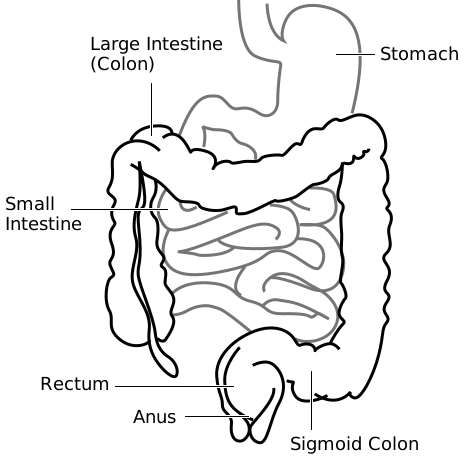
Digestive processes in large intestine: This image shows the relationship of the colon to the other parts of the digestive system.
The big intestine takes about sixteen hours to finish up the remaining processes of the digestive arrangement. Nutrient is no longer broken down at this stage of digestion. The colon absorbs vitamins created by the colonic bacteria—such every bit vitamin Chiliad (particularly of import as the daily ingestion of vitamin 1000 is not unremarkably enough to maintain adequate blood coagulation), vitamin B12, thiamine, and riboflavin. It too compacts feces, and stores fecal matter in the rectum until it tin can be defecated.
Gut Flora
Gut flora consists of microorganisms that live in the digestive tracts of animals—the gut is the largest reservoir of human being flora. The human trunk, which consists of near 10 trillion cells, carries most ten times every bit many microorganisms in the intestines.
The metabolic activities performed by these bacteria resemble those of an organ, leading some to liken gut bacteria to a forgotten organ. It is estimated that these gut flora have around a hundred times as many genes in aggregate every bit there are in the human genome.
Bacteria brand up most of the flora in the colon and up to 60 percent of the dry mass of feces. Somewhere betwixt 300 and 1000 different species live in the gut, with most estimates at virtually 500. Ninety-nine per centum of the bacteria probably come from virtually xxx or 40 species.
Research suggests that the relationship between gut flora and humans is not but commensal (a non-harmful coexistence), just rather a mutualistic relationship. Though people tin can survive without gut flora, the microorganisms perform a host of useful functions, such equally:
- Fermenting unused free energy substrates.
- Grooming the allowed system.
- Preventing growth of harmful, pathogenic bacteria.
- Regulating the development of the gut.
- Producing vitamins for the host (such as biotin and vitamin Thou).
- Producing hormones to direct the host to shop fats.
Gut Flora and Specialized Digestion
Bacterial flora: Escherichia coli, one of the many species of leaner present in the human being gut.
Without gut flora, the human body would be unable to utilize some of the undigested carbohydrates information technology consumes. Some types of gut flora have enzymes that human cells lack for breaking down certain polysaccharides. Carbohydrates that demand bacterial assistance for digestion include:
- Certain starches.
- Fiber.
- Oligosaccharides and sugars like lactose (in the instance of lactose intolerance) and sugar alcohols.
- Fungus produced past the gut.
- Various proteins.
Fermentation
Bacteria turn the carbohydrates they ferment into short-chain fatty acids (SCFAs) by a class of fermentation called saccharolytic fermentation. These SCFAs include acetic acid, propionic acid, and butyric acid.
SCFAs tin be used past host cells as a major source of useful free energy and nutrients for humans. They also assist the trunk blot essential dietary minerals such as calcium, magnesium, and atomic number 26. Evidence indicates that leaner enhance the assimilation and storage of lipids and produce and aid the absorption of needed vitamins, such as vitamin K.
Absorption and Feces Formation in the Big Intestine
The large intestine absorbs water from the chyme and stores feces until they tin be defecated.
Learning Objectives
Draw the process of absorption and carrion formation in the big intestine
Key Takeaways
Cardinal Points
- Partially digested food passes from the small intestine to the large intestine or colon.
- Within the colon, digestion is retained long enough to permit fermentation via gut bacteria that break down some of the substances that remain after processing in the modest intestine.
- The large intestine houses over 700 species of bacteria that metabolize polysaccharides into short-chain fatty acids that produce large amounts of vitamins —especially vitamin Chiliad and biotin—and gas.
- The normal flora of bacteria in the large intestine is essential in the development of certain tissues, including the cecum and lymphatics.
Key Terms
- feces: Digested waste material cloth that is discharged from the bowels; excrement.
- polysaccharide: A polymer made of many saccharide units that are linked by glycosidic bonds.
- anal sphincter: A band muscle that surrounds the anus (anal orifice).
After the food has been passed through the small intestine, it enters the large intestine. Inside the large intestine, digestion is retained long enough to permit fermentation via gut bacteria that suspension downwards some of the substances that remain after processing in the small intestine.
Some of the breakdown products are absorbed. In humans, these include nearly complex saccharides (at almost, three disaccharides are digestible by humans).
Abdominal Bacteria
The large intestine houses over 700 species of leaner that perform a variety of functions. The large intestine absorbs some of the products formed by the bacteria that inhabit this region.
Undigested polysaccharides (fiber) are metabolized into short-chain fatty acids past bacteria in the large intestine and go absorbed past passive diffusion. The bicarbonate that the large intestine secretes helps to neutralize the increased acidity from the formation of fatty acids.
Intestinal bacteria also produce large amounts of vitamins, especially vitamin K and biotin (a B vitamin), which are captivated into the blood. Although this source of vitamins provides merely a small part of the daily requirement, information technology makes a significant contribution when dietary vitamin intake is low. An individual that depends on assimilation of vitamins formed past bacteria in the large intestine may become vitamin-deficient if treated with antibiotics that inhibit other species of bacteria while targeting the affliction-causing bacteria.
Other bacterial products include gas (flatus)—a mixture of nitrogen and carbon dioxide, with modest amounts of the gases hydrogen, methane, and hydrogen sulphide. The bacterial fermentation of undigested polysaccharides produces these gases.
Intestinal flora are also essential for the development of certain tissues, including the cecum and lymphatics.
H2o and Cellulose
The large intestine absorbs h2o from the chyme and stores carrion until it tin exist defecated. Nutrient products that cannot go through the villi, such every bit cellulose (dietary cobweb), are mixed with other waste products from the body and become hard and concentrated feces.
The feces is stored in the rectum for a certain period and and so the stored feces is eliminated from the body due to the contraction and relaxation of the anus. The get out of this waste fabric is regulated by the anal sphincter.
Defecation Reflex
Defecation is a combination of voluntary and involuntary processes that create plenty force to remove waste material material from the digestive system.
Learning Objectives
Depict the defecation reflex
Key Takeaways
Key Points
- The rectal ampulla acts equally a temporary storage facility for the unneeded digestive material.
- A sufficient increase in fecal cloth in the rectum causes stretch receptors from the nervous system that are located in the rectal walls to trigger the wrinkle of rectal muscles, the relaxation of the internal anal sphincter, and an initial contraction of the skeletal muscle of the external sphincter.
- The relaxation of the internal anal sphincter causes a betoken to exist sent to the brain indicating an urge to defecate.
- If defecation is delayed for a prolonged flow, the fecal affair may harden and autolyze, and result in constipation.
- Once the voluntary point to defecate is sent back from the encephalon, the ano-rectal angle decreases, becoming almost straight, and the external anal sphincter relaxes. The rectum contracts and shortens in peristaltic waves, forcing fecal material out of the rectum and down through the anal canal.
Fundamental Terms
- defecation: The act or procedure of voiding feces from the bowels.
- rectum: The terminal part of the big intestine through which feces laissez passer.
- anal canal: The last part of the large intestine, situated betwixt the rectum and anus.
- constipation: A state of the bowels in which the evacuations are infrequent and difficult, or the intestines become filled with hardened feces.
- autolyze: To destroy itself; to be destroyed by its ain enzymes.
Examples
Constipation is uncomfortable, but information technology may be a point that your diet is scarce in fibrous foods (consume more fruits and vegetables) and that you are not drinking plenty water, so laxatives are generally not the all-time way to care for it.
Defecation
For the adult human, the process of defecation is commonly a combination of both voluntary and involuntary processes that create enough force to remove waste cloth from the digestive system.
The rectal ampulla acts as a temporary storage facility for the unneeded fabric. As boosted fecal fabric enters the rectum, the rectal walls aggrandize. A sufficient increase in fecal cloth in the rectum causes the stretch receptors from the nervous system, located in the rectal walls, to trigger the contraction of rectal muscles, the relaxation of the internal anal sphincter, and an initial wrinkle of the skeletal muscle of the external sphincter. The relaxation of the internal anal sphincter causes a signal to be sent to the brain indicating an urge to defecate.
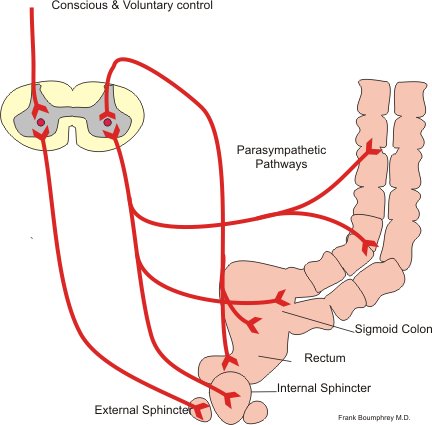
Defecation reflex: The conscious and parasympathetic pathways of the defecation reflex.
If this urge is not acted upon, the cloth in the rectum is often returned to the colon by reverse peristalsis where more water is absorbed, thus temporarily reducing pressure and stretching within the rectum. The additional fecal fabric is stored in the colon until the next mass peristaltic movement of the transverse and descending colon. If defecation is delayed for a prolonged menses, the fecal thing may harden and autolyze, resulting in constipation.
Once the voluntary signal to defecate is sent back from the encephalon, the final phase begins. The abdominal muscles contract (straining), causing the intra-intestinal pressure level to increase. The perineal wall is lowered and causes the anorectal angle to subtract from ninety degrees to less than xv degrees (almost straight), and the external anal sphincter relaxes.
The rectum at present contracts and shortens in peristaltic waves, thus forcing fecal material out of the rectum and down through the anal canal. The internal and external anal sphincters, along with the puborectalis musculus, let the feces to be passed past pulling the anus up and over the exiting feces in shortening and contracting deportment.
Source: https://courses.lumenlearning.com/boundless-ap/chapter/the-large-intestine/
0 Response to "Which Structure Stores Feces Until They Can Be Eliminated?"
Post a Comment